Engineering & Environmental Research |
|||||
DF Dickins Associates Ltd.
|
![]() |
||||
|
News
![]() Arriving at McKinley Bay, winter 1979.
![]() Ice thickness radar trials off Tuktoyaktuk, winter 1973.
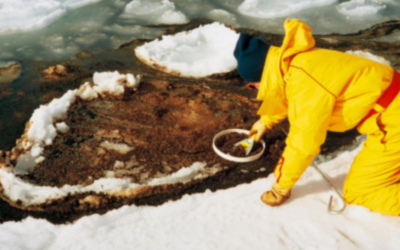
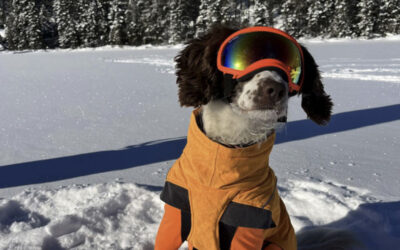
![]() Previous large-scale experimental spill in broken ice off Svalbard in 1993. Photo: SINTEF This program is funded by a group of international oil companies and government agencies committed to examining the science, engineering and response to accidental oil spills in ice. The program is being run by SINTEF in Trondheim, Norway. DF Dickins Associates is a participating R&D organization charged with managing the remote sensing project within the overall program. A technology screening report submitted December 2007 reviewed the available sensor technologies that could have applications to the oil in ice problem, including from the ice surface, ship-based, aircraft systems and satellites. The remote sensing project also incorporates a program to train dogs in detecting crude oil buried under ice or snow, managed by Dr. Per Johan Brandvik of SINTEF in conjunction with Turid Buvik of Trondheim Hundeskole, a specialized group of animal trainers. Phase 1 in this activity has achieved significant success with demonstrated trials documented on video. Plans are now under way to involve several of the world’s most advanced airborne surveillance systems in a series of experimental spills being planned for 2008 and 2009 off Svalbard. In addition, consideration is being given to testing ground-penetrating radar in an airborne mode in March 2008 (again on Svalbard) to demonstrate the ability to detect and map oil on the ice surface buried under snow from a low-flying helicopter.
Highly Acclaimed Workshop October 10 / 11, 2007 Anchorage, Alaska
Organized by: ![]()
![]() Barges off Prudhoe Bay Photo: Crowley NEW STUDY - Transportability Of Fabricated Modules Through The Canadian Northwest Passage DF Dickins is supporting BMT Fleet Technology of Ottawa in a study for Petroleum Research Atlantic Canada on behalf of a group of oil and gas majors with interests in Mackenzie Valley gas developments. Our contribution includes the development of historical ice databases focusing on the eastern access route into the Beaufort Sea via the traditional Northwest Passage through Lancaster Sound to Coronation Gulf.
![]() Hylje specialized oil spill response vessel responding to an accidental spill in the Baltic. Photo: Finnish Environment Institute. NEWLY COMPLETED STUDY – for StatoilHydro, Norway Dickins Associates was selected in mid-2007 to provide a Review of Methods to Deal with Accidental spills in Ice-covered Waters focusing on a number of specific Arctic areas. The study scope covered a wide range of topics: overview of response infrastructure, political and regulatory issues, local sensitivities, sea ice environments, fate and behaviour of oil, response methods and an overall assessment of response applicability in the different regions with a summary of response capability. The final report will be submitted January 2008. Findings are proprietary at this time.
NEW AND UPCOMING PUBLICATIONS Dickins D., Brandvik, P.J., Bradford, J., Faksness, L-G, Liberty, L., and R. Daniloff. Svalbard 2006 Experimental Oil Spill Under Ice: Remote Sensing, Oil Weathering Under Arctic Conditions and Assessment of Oil Removal by In-situ Burning. Paper accepted for presentation at the 2008 International Oil Spill Conference, May 4 –8, 2008 Savannah, Georgia. Dickins, D., Cox, M. and J. Thorliefson. Arctic Patrol Hovercraft: an Initial Feasibility Study. Paper accepted for presentation at Ice Tech 2008, Banff Alberta, July 20-23, 2008. Dickins, D.F. and A.A. Allen. August 2007. Shell’s Beaufort Sea Exploratory Drilling Program Oil Spill - Response in Ice. Prepared for Shell Exploration and Production, New Orleans and Anchorage – released for public distribution. Allen, A.A., Dickins D.F. and S. M. Moore. Shell Develops Spill-response Program for Beaufort Work. Oil and Gas Journal Nov. 12, 2007.
![]() DF Dickins continues to provide engineering and technical support to Shell’s proposed Beaufort Sea exploration program, working directly through Shell’s Anchorage and Houston offices and ASRC Energy Services. Specialized services include advising on environmental issues as well as strategic planning for marine operations in ice and development of historical ice databases. As part of the permit and approvals process, Dickins worked with a long-time associate, Alan Allen of Spiltec to prepare a publication covering many aspects of oil spill response in ice. This report was produced by Shell E&P in October 2007 and distributed at the Oil & Ice Workshop in Anchorage. Click here to view this report.
![]() Survey team at Prudhoe, June 2007 with the helicopter used for mapping the Colville overflood boundary. ![]() SPOT image acquired within 48 hours of the helicopter survey showing the overflood area (red arrow) off the Colville River. Ground resolution 10 m. ONGOING LONG-TERM PROJECT – for the US Department of Interior, Minerals Management Service, Anchorage Dickins Associates is managing a team comprising Coastal Frontiers, Aerometric, and the University of Alaska Fairbanks to develop a Geodatabase of sea ice overflood over the period 1995 to 2007 for all of the major rivers discharging into the Alaskan Beaufort Sea. The study uses historical satellite imagery (both visible and radar) to map overflood boundaries into a GIS with supporting databases on environmental factors such as temperature and streamflow. A successful helicopter survey over the Colville Delta in June 2007 gathered GPS waypoints along the overflood boundary off the Colville Delta and was used to calibrate different satellite sensors in terms of their mapping capabilities (Landsat, SPOT, MODIS, ERS, and Radarsat). The study is on schedule with a final report is scheduled for delivery early in 2009.
![]() Burning oil on the ice at Svea, Svalbard 2006. Photo: SINTEF. ![]() This long term project involves a cooperative effort with the Boise State University Center for Geophysical Investigation of the Shallow Subsurface (CGISS). Development started in 2004 with cold basin testing of ground penetrating radar to detect oil trapped under ice at CRREL NH, and evolved in 2006 to include a successful experimental spill under ice on Svalbard with SINTEF and UNIS, (see photos). See also Projects – Oil Spills for a summary of progress. Phase 3 is now underway, fully funded by MMS. This work involves modeling the radar performance in different oil and ice situations with the ultimate goal of developing a higher powered radar system that can detect oil under solid ice from a low flying helicopter. In a related activity, Alaska Clean Seas and the Alaska Department of Environmental Conservation have agreed to fund a field demonstration and workshop to train responders in the use of portable GPR systems to detect oil under snow and ice. ACS recently purchased one of these systems as part of their response inventory on the North Slope. This workshop is now tentatively scheduled to take place at Prudhoe Bay in April 2008.
![]() Vertical thin section viewed through polarized light of an ice core taken from the SL Ross indoor ice tank. Michelle Johnston - NRC 2007 ONGOING - Empirical Weathering Properties of Oil in Snow & Ice Dickins is assisting SL Ross Environmental Research in a three-year program of lab, tank and field tests to investigate the behavior of oil in snow and ice. The program funded by the US Minerals Management Service includes experimental spills of oil on the surface and beneath the ice. Recent activities involve examining trends between environmental variables and oil properties affecting the rate of oil migration (vertical rise) through the ice. The final study report will be released for public distribution in 2008.
|
|||||||||||||